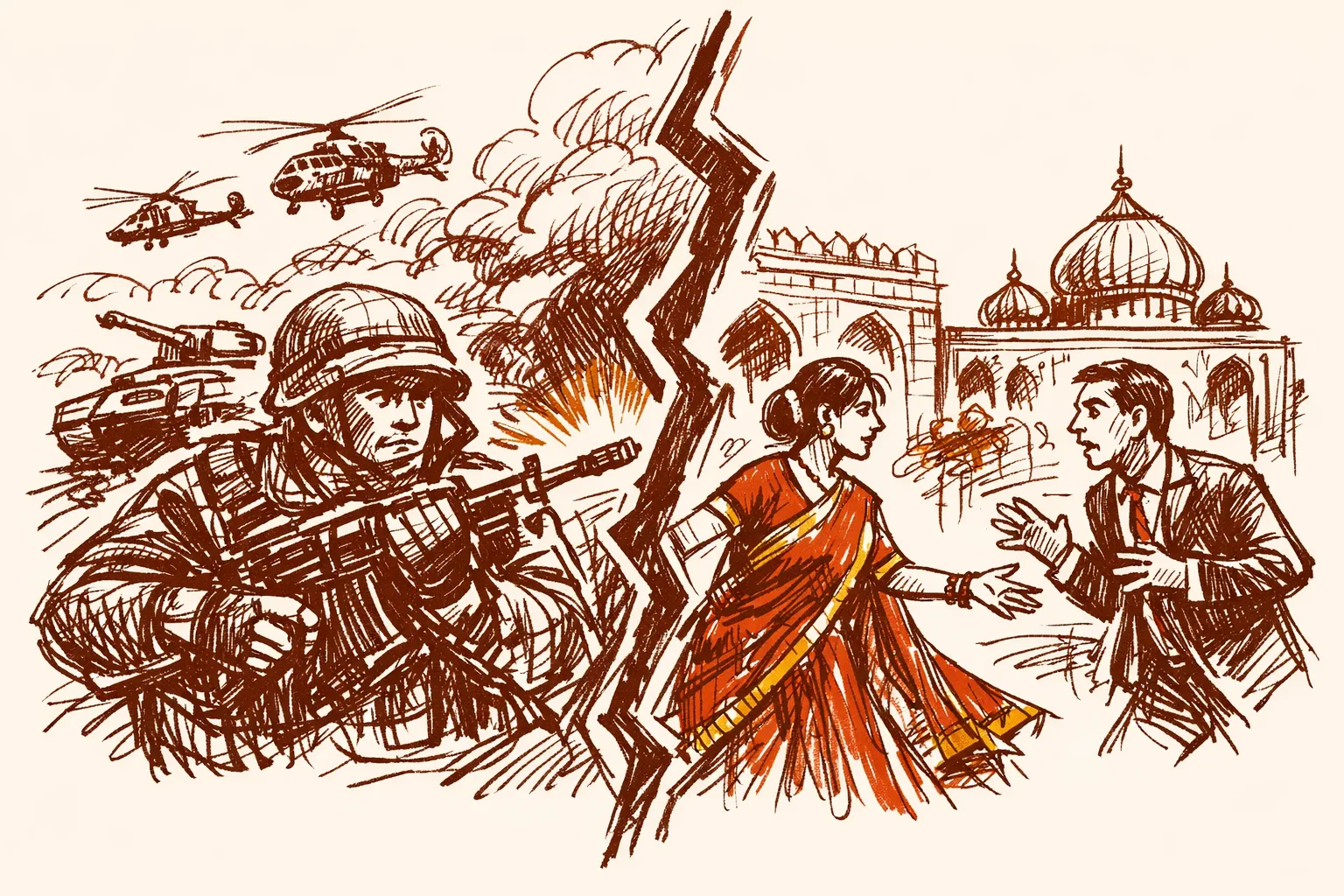
The Night Everything Changed
At 1:05 AM on May 7, the Indian Air Force struck nine targets inside Pakistan and Pakistan-occupied Kashmir simultaneously. The targets included the headquarters of Jaish-e-Mohammed in Bahawalpur and the main training facility of Lashkar-e-Taiba in Muridke - both deep inside Pakistani Punjab, over 600 kilometres from the Line of Control. More than 100 terrorists were killed. Both headquarters had functioned openly for decades.
Fifteen days earlier, 26 tourists had been murdered near Pahalgam in Jammu and Kashmir. Gunmen from The Resistance Front - a proxy outfit of Lashkar-e-Taiba - separated victims by religion and shot them at close range. Women were told to deliver a message to the Prime Minister. One local pony-ride operator died trying to save the tourists. Several victims were newlyweds.
India had seen this before. Parliament attacked in 2001. Mumbai bombed in 2008. Pulwama in 2019. Every time, India absorbed the pain and chose diplomatic responses. Every time, Pakistan read that restraint as permission to continue. Operation Sindoor said: no more.
The Scale of What Happened
The operation lasted exactly 88 hours. It was the largest Indian military action since the 1971 war. India deployed its Air Force, Army, and Navy in a coordinated tri-service campaign - the first of its kind in India's post-independence history.
Pakistan retaliated with drone and missile swarms, then launched Operation Bunyan-un-Marsoos targeting Indian air bases. India escalated. On May 10, India used the BrahMos supersonic cruise missile to strike 11 Pakistani air bases in 45 minutes. Radar systems, hangars, runways, and command centres were destroyed. Air Marshal Sanjeev Kapoor (Retd.) said: "That was a game-changer. It brought them to the table for a ceasefire."
Pakistan's Director General of Military Operations called his Indian counterpart. The ceasefire was announced on May 10. Pakistan asked for the ceasefire. India chose the terms.
Satellite imagery from Maxar Technologies showed visible destruction at six Pakistani air bases: Sukkur, Rahim Yar Khan, Sargodha, Jacobabad, Bholari, and Nur Khan. Runways were cratered. Hangars came down. The command structures were gone.
The Three Pillars of the New Doctrine
PM Modi addressed the nation on May 12 in a 22-minute speech. He stated India's new posture in three clear points. First: assured retaliation on India's terms. "We will give a befitting response on our terms only. We will take strict action at every place from where the roots of terrorism emerge." Second: no more nuclear blackmail. "India will not tolerate any nuclear blackmail. India will strike precisely and decisively at terrorist hideouts developing under the cover of nuclear blackmail." Third: no distinction between terrorists and their state sponsors. "We will not differentiate between the government sponsoring terrorism and the masterminds of terrorism."
Modi also declared the operation "paused, not concluded." India would watch Pakistan's actions and decide next steps accordingly.
Air Chief Marshal Amar Preet Singh distilled the doctrine into three words: Achuuk (unerring), Abhed (impenetrable), Sateek (precise). In practice: India identifies the target, strikes it exactly, and defends against everything incoming.
Defence Minister Rajnath Singh told Parliament that India stopped when it chose to - "on our own terms" - having achieved its primary aims.
What Has Already Been Tried
India did not arrive at this doctrine overnight. It took three failed attempts to get here.
After the Parliament attack of 2001, India launched Operation Parakram - moving roughly 500,000 troops to the Pakistan border. The mobilisation took three weeks. That delay gave Pakistan time to counter-deploy and signal its nuclear readiness. US pressure intensified. India stood down. Former Navy Chief Admiral Sushil Kumar later called it a "punishing mistake" that lacked clear objectives. Operation Parakram cost India approximately Rs. 2,100 crore over ten months without a single shot fired at a terror target.
The 2008 Mumbai attacks killed 166 people. India chose a legal-diplomatic response. The case against the main handlers dragged through Pakistani courts for years. The perpetrators remained free.
In 2016, Indian Army special forces crossed the Line of Control after the Uri attack killed 19 soldiers. The surgical strikes hit launchpads 2 to 3 kilometres inside Pakistan-controlled territory. Pakistan denied the strikes even happened.
In 2019, the Indian Air Force struck a Jaish-e-Mohammed training camp in Balakot after the Pulwama bombing killed 40 CRPF personnel. Pakistan retaliated the next morning. India lost an aircraft. The pilot was captured and returned. Both sides stepped back. The Balakot strikes achieved symbolic impact but did not hit headquarters.
Each of these responses delivered a message. None delivered a cost high enough to change Pakistan's calculus. The common thread: India stopped when Pakistan rattled its nuclear weapons. Operation Sindoor did not stop.
The Nuclear Dimension - The Biggest Strategic Change
Pakistan's entire counter-terror strategy for 25 years rested on one assumption: that its nuclear weapons would freeze India's conventional response. Strike India through proxies, then wave the nuclear flag, wait for US diplomatic intervention, and resume as before. The Bulletin of the Atomic Scientists confirmed this logic failed: "Pakistan's deterrence logic was undermined during the four-day conflict in May, when India ignored Islamabad's nuclear signalling and established what Prime Minister Modi described as a 'new normal.'"
The Observer Research Foundation explained directly: "To neutralise India's conventional military strength, Pakistan has become excessively reliant on a first-use nuclear posture, which is not very credible, as Operation Sindoor visibly demonstrated."
Pakistan's nuclear threat needs delivery systems to be credible - land, air, and sea. India's strikes on 11 air bases degraded Pakistan's air-vector delivery capacity. India's Navy had already contained Pakistan's maritime vector in the Arabian Sea. What remained was Pakistan's land-based arsenal - but even that required command authority from the Strategic Plans Division, located near the Nur Khan base that India had just struck.
Pakistan's Prime Minister reportedly convened the Nuclear Command Authority on May 10. Pakistani ministers later denied any nuclear option was discussed. Professor Brahma Chellaney wrote that India had "pierced the perceived immunity conferred by Pakistan's nuclear deterrent - an umbrella under which Pakistan long exported terrorism with relative impunity."
Pakistan's nuclear bluff was called. India struck and waited. Pakistan blinked.
What This Proved About Chinese Weapons
Pakistan's defence system runs almost entirely on Chinese hardware. The conflict tested that hardware under real combat conditions - and the results were damaging for Beijing. Pakistan's Chinese-made HQ-9B long-range air defence system - marketed as a high-end competitor to Russia's S-300 - failed to intercept Indian missiles and drones. The system reportedly could not stop a single Indian missile from reaching its target.
The JF-17 fighter aircraft, jointly developed by Pakistan and China, did not prevent Indian strikes on strategic sites. The J-10C fighter jet and PL-15 beyond-visual-range missile showed no conclusive tactical success. India recovered an intact PL-15E missile that had been fired at Indian jets and missed.
India's indigenous systems performed. The Akashteer air defence network achieved near-total drone kill rates. The BrahMos missile struck 11 air bases in 45 minutes. The Harop loitering munition executed precision strikes. The DRDO-developed electronic warfare suite jammed Chinese-supplied radars in Pakistan. Indian defence stocks surged 49 per cent in the aftermath.
Operation Sindoor was the first major modern conflict where Chinese systems faced an integrated air force equipped with Western, Russian, Israeli, and indigenous technologies simultaneously. Countries across Southeast Asia and Africa began reconsidering Chinese hardware contracts.
How Other Countries Fixed Similar Problems
Israel's Doctrine of Escalation Dominance
Israel faced decades of rocket attacks and cross-border terrorism from groups backed by state sponsors. Its response doctrine is built on one principle: the cost of attacking Israel must always exceed the attacker's gain. Israel strikes command infrastructure, not just field operatives. Operation Sindoor mirrors this logic - India struck the headquarters, not just the launchpads. India is now applying this doctrine to a nuclear-armed neighbour, which is without precedent.
The United States Post-9/11 Doctrine
After the September 11 attacks, the US declared it would not distinguish between terrorists and the governments that shelter them. India's May 12 declaration - "we will not differentiate between the government sponsoring terrorism and the masterminds of terrorism" - is the Indian equivalent. The US backed that declaration with the full weight of its military. India is now building toward the same posture through indigenous capability.
Turkey's Doctrine of Cross-Border Pursuit
Turkey has conducted dozens of cross-border military operations into Iraq and Syria targeting PKK terror infrastructure, often without prior UN approval, framing these as acts of self-defence under Article 51 of the UN Charter. India adopted a similar framing - Operation Sindoor was described as a "focused, measured and non-escalatory" response to terror infrastructure. Turkey faces conventional threats; India faces a nuclear-armed adversary. Managing this without nuclear escalation is the doctrinal achievement.

Who Is Accountable
On Pakistan's side, the accountability is documented. Pakistan Army Chief Asim Munir delivered a speech weeks before the Pahalgam attack calling Kashmir Pakistan's "jugular vein" and declaring that Hindus and Muslims are "different in every possible way." Days later, Hindus were selectively targeted and killed in Baisaran meadow. Pakistani Army officers gave state funerals to Lashkar-e-Taiba terrorists killed at Muridke - documented in photographs that circulated globally. While terrorists are cremated with full state honours and senior Army officers attend, they can no longer be called non-state actors.
44 members of the US Congress demanded sanctions against the Pakistan Army chief following Operation Sindoor.
On India's side, accountability for what happens next rests with three institutions. The Ministry of Defence holds the emergency procurement mandate - it approved Rs. 40,000 crore in emergency procurement authority post-Sindoor. The Chief of Defence Staff, Lt. General NS Raja Subramani - who spearheaded the operation's planning - holds responsibility for tri-service integration. The Ministry of External Affairs, led by S. Jaishankar, is accountable for keeping the Indus Waters Treaty in abeyance and the diplomatic pressure campaign active.
What Would It Cost
Operation Sindoor had an immediate economic impact - but mostly for Pakistan. India's defence exports hit Rs. 38,424 crore in the financial year following the operation, a 62.66 per cent jump year-on-year. The private sector contributed nearly half of total exports - Rs. 17,352 crore - a 54 per cent year-on-year increase. India now exports defence equipment to more than 80 countries.
The Indus Waters Treaty suspension is India's most powerful non-military lever. The Indus basin supplies water for roughly 80 per cent of Pakistan's agriculture. India has accelerated construction on hydropower projects on the Chenab River - including Pakal Dul (1,000 MW), Kiru (624 MW), Kwar (540 MW), and Ratle (850 MW) - and Jammu and Kashmir may see a 46 per cent increase in installed hydropower capacity this year.
Pakistan increased defence spending by roughly 20 per cent to approximately 2.55 trillion rupees in its 2025-26 budget - even as overall public spending was cut by 7 per cent. The IMF disbursed 1 billion dollars to Pakistan during the conflict itself to prevent economic collapse. India's defence production base has grown 174 per cent over the past decade.
What Needs to Happen Next
The doctrine has been declared. Four things must follow to make it permanent.
First, tri-service integration must move from doctrine to daily practice. Operation Sindoor proved the concept works. That coordination needs to be institutionalised at every level, not just at the top.
Second, India must accelerate indigenous defence production. The Akashteer system, BrahMos, and Harop loitering munitions proved themselves in combat. The next generation - the Advanced Medium Combat Aircraft, counter-drone networks, hypersonic systems - must follow on a faster timeline.
Third, the Indus Waters Treaty must remain in abeyance as long as Pakistan's terror infrastructure is intact. MEA spokesperson Randhir Jaiswal made India's position clear: "IWT stands in abeyance in response to Pakistan's sponsorship of cross-border terrorism. Pakistan must credibly and irrevocably abjure its support for cross-border terrorism." This leverage must not be quietly abandoned in back-channel diplomacy.
Fourth, India must lead international pressure for formal audit and oversight of Pakistan's nuclear arsenal. Defence Minister Rajnath Singh called for International Atomic Energy Agency supervision of Pakistan's nuclear weapons. Nuclear weapons in the hands of an army that gives state funerals to designated terrorists are a global security problem, not just India's.
Growing up in Himachal Pradesh, we lived close enough to the border to feel what Pahalgam meant. The grief was not abstract. Neither was the satisfaction when India finally answered with something more than a press conference.