The Meadow in Pahalgam
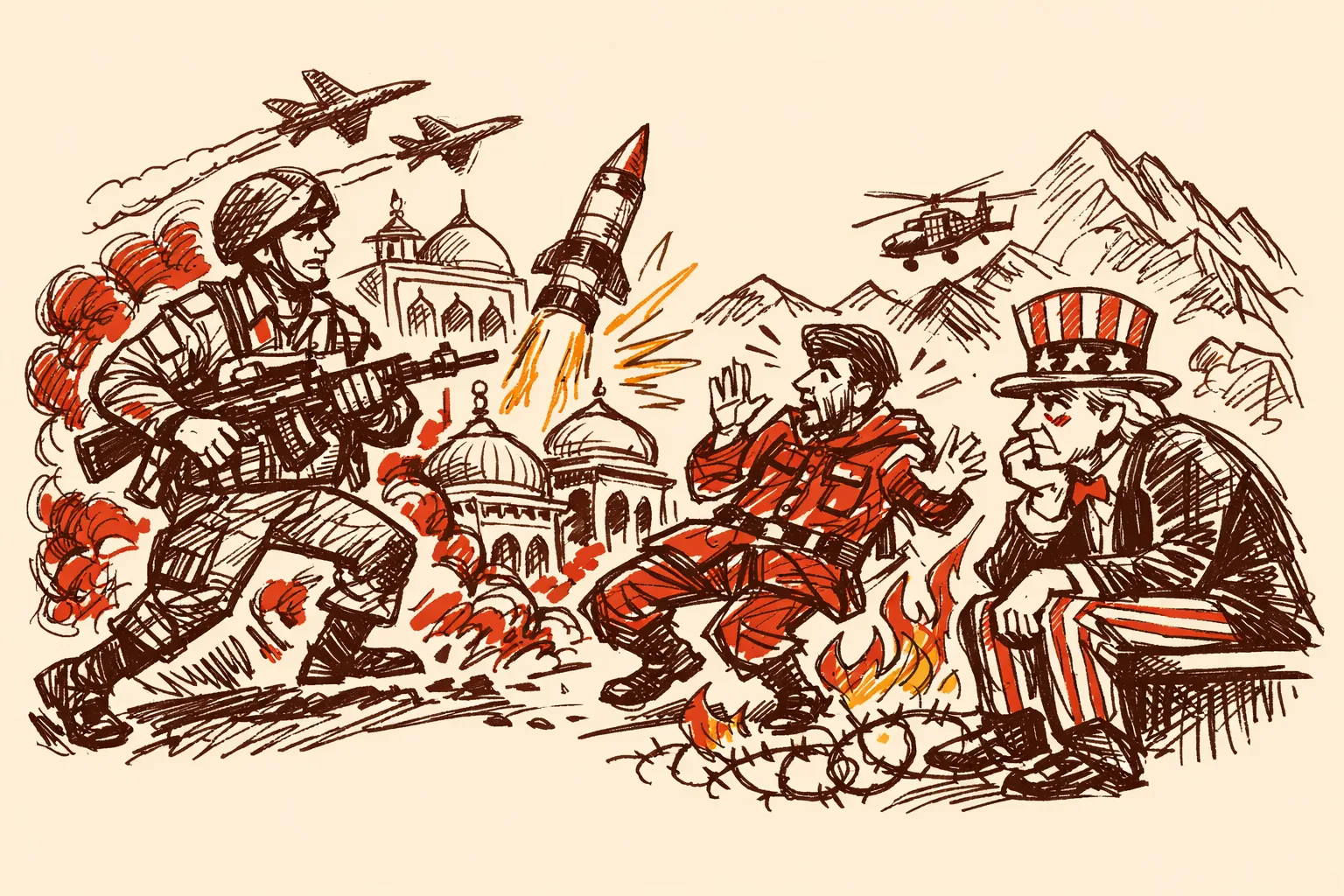
On April 22, five gunmen walked into a meadow near Pahalgam, a mountain town in Jammu and Kashmir popular with tourists. They asked people their religion. Then they opened fire. Twenty-six civilians were killed. Twenty-five of the dead were Hindu tourists who had come for the mountain air and the meadows. One was a local Muslim pony-ride operator who tried to stop the attackers.
India's National Investigation Agency chargesheeted Lashkar-e-Taiba and its proxy group, The Resistance Front, for the attack. The Resistance Front had initially claimed responsibility - twice - before retracting.
This was the deadliest attack on Indian civilians since the 2008 Mumbai massacre. And it happened less than a year after Pakistan had been removed from the Financial Action Task Force grey list - a global watchdog's list of countries that fail to stop terror financing.

What Two US Reports Just Confirmed
In the last two weeks, two major American institutions published reports that confirmed what India has argued for thirty years.
The first came from the US Congressional Research Service - an independent research body that briefs American lawmakers. Updated on March 25, the report was prepared by South Asia specialist K. Alan Kronstadt. It identifies Pakistan as a base of operations for 15 major armed and terrorist groups. Twelve of those 15 are formally designated as Foreign Terrorist Organizations under US law.
The report names the groups that target India directly: Lashkar-e-Taiba, Jaish-e-Mohammed, Hizbul Mujahideen, Harakat-ul Jihad Islami, and Harakat ul-Mujahidin. Hizbul Mujahideen alone has an estimated 1,500 armed cadre. Jaish-e-Mohammed has roughly 500 armed supporters spread across Pakistan, Afghanistan, and India.
The report's most damning line is also its most honest. It states that "several major military offensives, including airstrikes, and hundreds of thousands of 'intelligence-based operations' have failed to defeat the numerous US- and United Nations-designated terrorist groups that continue to operate on Pakistani soil."
The second report came from the Center for a New American Security - a Washington think tank - authored by Lisa Curtis, Keerthi Martyn, and Sitara Gupta. Titled "Repairing the Breach: Getting US-India Ties Back on Track," it notes that India "has been disappointed by the overall lack of US attention to the problem of terrorism that emanates from Pakistan" - even after Washington designated The Resistance Front as a Foreign Terrorist Organization after Pahalgam. The report also warns Washington to "refrain from talking about mediating the India-Pakistan dispute over Kashmir."
America's own Congress researchers confirm Pakistan shelters the groups. America's own policy analysts confirm India is right to be disappointed. And yet the Trump administration has simultaneously pursued what it called a "decisive reset" in US-Pakistan relations - including warm outreach to Pakistan's Army Chief, General Asim Munir.
India's position has been validated. The next step is not waiting for Washington to act on it.
The Scale of the Problem
Pakistan is not just a source of terrorism targeting India. It is now the most terrorism-affected country on Earth. The Global Terrorism Index, published by the Institute for Economics and Peace, ranked Pakistan number one out of 163 countries - the first time it has ever held that position.
Pakistan recorded 1,139 terrorism deaths and 1,045 incidents in a single year. That is its highest toll since 2013. It is also the sixth consecutive year that terrorism deaths in Pakistan have risen.
The provinces of Khyber Pakhtunkhwa and Balochistan accounted for 74 percent of attacks and 67 percent of deaths. Pakistan now sits alongside Burkina Faso, Nigeria, Niger, and the Democratic Republic of Congo as one of five countries where nearly 70 percent of all global terrorism deaths occur.
Here is the central reality: Pakistan is simultaneously the world's leading exporter of terrorism targeting India and the world's leading victim of terrorism blowback. The infrastructure it built to target India - the madrassas, the militia networks, the ISI directorate that funds them - has now turned inward and is consuming the country. Pakistan's economy is in free fall. Its political system is in chaos. A state that cannot control the forces it created is not a stable partner for anyone - including Washington.

India's Escalating Response - And Why It Is Working
India has not been passive. Under BJP governance, the response to each attack has grown sharper and more decisive.
After the 2001 Indian Parliament attack, carried out by Jaish-e-Mohammed and Lashkar-e-Taiba, India mobilized troops to the border in what became Operation Parakram. International pressure pushed both sides back.
After the 2008 Mumbai attacks - 166 people killed over three days by Lashkar-e-Taiba - India presented evidence to Pakistan and demanded action. This was during the Congress-UPA era. Pakistan's courts arrested LeT commander Zakiur Rehman Lakhvi and then released him on bail. The judicial process in Pakistan went nowhere for over a decade. The Congress government's response did not move beyond diplomacy.
After the 2016 Uri attack, the Modi government launched Surgical Strikes - cross-border operations targeting militant launch pads along the Line of Control - the first time India had struck across the border in the modern era. The era of strategic restraint was over.
After the 2019 Pulwama attack - 40 paramilitary soldiers killed by a Jaish-e-Mohammed suicide bomber - the Modi government launched the Balakot airstrikes, striking deep inside Pakistan proper for the first time since 1971.
After the Pahalgam massacre, India launched Operation Sindoor: drone and missile strikes on nine terror infrastructure sites in Pakistan and Pakistan-administered Kashmir, including the alleged Lashkar-e-Taiba headquarters and the Jaish-e-Mohammed compound in Bahawalpur - 150 kilometers inside Pakistan. Defence Minister Rajnath Singh said at least 100 militants were killed. The strikes were followed by three days of cross-border aerial and artillery exchanges before a ceasefire on May 10.
Each response under BJP governance has been larger and more credible than the last. Operation Sindoor established that India will strike deep, strike precisely, and accept the escalation risk. Pakistan's army knows this now.
On the diplomatic side, India suspended the Indus Waters Treaty - a 1960 water-sharing agreement that survived three wars - citing Pakistan's support for cross-border terrorism. It was the first time India had ever followed through on a threat made multiple times before. The Congress-era governments in 2016 and 2019 threatened the same suspension and did not act. This government acted.
Pakistan designated the suspension an "act of war." Army Chief Asim Munir reportedly warned at a dinner in Florida that Pakistan would destroy any dam India builds. Former Pakistani Foreign Minister Bilawal Bhutto separately threatened that Pakistan would "secure all six rivers" if water was not shared. The ferocity of that reaction confirms the suspension is working.
The Financial Action Task Force placed Pakistan on its grey list three separate times: in 2008, 2012, and 2018. Pakistan was removed in October 2022 after completing a 34-point action plan. Each removal came with the same result: the underlying machinery of terror finance stayed intact. Groups simply rebranded. Lashkar-e-Taiba renamed its public face to Jamaat-ud-Dawa. Jaish-e-Mohammed collected funds through front charities. The Congressional Research Service report confirms these same groups are still operating today - three years after Pakistan was declared clean. The FATF process, as designed, is not enough. India must go further.
How Other Countries Have Built Lasting Pressure
The United States after 2001
After the September 11 attacks, the US invaded Afghanistan, dismantled the Taliban government that hosted Al-Qaeda, and built a global financial sanctions architecture that froze assets and cut off banking access for anyone linked to designated groups. The US Treasury's Office of Foreign Assets Control imposed sanctions on individuals, not just organizations - cutting off financiers, recruiters, and logistics coordinators by name. Any bank anywhere in the world that processed transactions for a designated entity faced US secondary sanctions. That made American financial designation globally painful, not just symbolically inconvenient.
India is now building toward an equivalent capability. Its designations under the Unlawful Activities Prevention Act currently apply to groups operating within Indian territory. The next step is reaching the financial networks in Pakistan, the Gulf, and Europe that fund Lashkar-e-Taiba and Jaish-e-Mohammed.
The European Union on Russia
After Russia's full-scale invasion of Ukraine, the EU built a coordinated sanctions regime that targeted not just Russian state entities but also third-country companies and individuals helping Russia evade sanctions through secondary sanctions. The lesson for India is the mechanism: secondary sanctions that reach through borders and punish enablers, not just perpetrators. India should build an equivalent tool for the financiers of Pakistani terror groups operating through Gulf-based charities and hawala networks.
Colombia on the FARC
Colombia's FARC was not broken by military force alone. The decisive shift came when the Colombian government combined military pressure with financial disruption: seizing narco assets, designating FARC fronts individually, and working with US Treasury to cut off the group's banking access internationally. A peace deal followed because the organization had become financially unsustainable.
The parallel for India is clear. Lashkar-e-Taiba and Jaish-e-Mohammed are also financial enterprises. The Hindu's OSINT analysis estimated ISI provides direct funding to LeT, while Jaish-e-Mohammed's Al-Rehmat Trust front charity collects tens of millions of dollars annually. Disrupting those financial flows - not just striking the military camps - is what a lasting response looks like. Operation Sindoor struck the camps. The financial architecture needs to be struck next.
Who Is Accountable
On the Pakistani side, the ISI's S-Wing is widely identified by Indian and Western analysts as the unit responsible for managing relations with militant groups. Lashkar-e-Taiba founder Hafiz Saeed remains on international sanctions lists and has been convicted inside Pakistan, but continues to operate through front organizations. Jaish-e-Mohammed founder Masood Azhar has never been prosecuted by Pakistan despite being on the UN sanctions list. Pakistan's army leadership, including General Asim Munir, continues to treat these groups as strategic assets even as they consume Pakistan's own stability.
On the American side, the Center for a New American Security report identifies two specific failures: Washington failed to consult India before announcing ceasefire terms after Operation Sindoor, and the Trump administration's simultaneous outreach to Pakistan undercut the message that the US takes terrorism against India seriously. These are Washington's failures to own - not India's.
India's Ministry of External Affairs and National Security Council - building on the BJP government's stronger posture - are now accountable for the next phase: building an international coalition that treats Pakistan-sponsored terrorism as a global problem, not a bilateral dispute. The groundwork from Operation Sindoor's international legitimacy must be converted into lasting coalition architecture.
What It Costs When India Does Not Act Fast Enough
Kashmir's tourism sector lost business immediately after the Pahalgam massacre as tourists canceled travel. Operation Sindoor itself required military mobilization whose costs have not been publicly disclosed.
The Center for a New American Security report notes that US-India defence cooperation was disrupted by the fallout from the ceasefire dispute. India's planned purchase of six additional Boeing P-8I maritime surveillance aircraft was put on hold when trade tensions spiked. Every Pakistan-sponsored attack carries downstream costs in investment confidence, defence procurement timelines, and diplomatic bandwidth. Faster financial and diplomatic pressure on Pakistan reduces the frequency of these disruptions.
Pakistan spent approximately 45 crore rupees - around 5.3 million US dollars - on six American lobbying firms during Operation Sindoor, according to US Foreign Agents Registration Act filings, to pressure Washington to stop India's military response. India spent nothing equivalent on public advocacy in Washington during the same period. This is an asymmetry India must close - and closing it is a straightforward investment with measurable returns in diplomatic leverage.
The Road Ahead - India Builds Its Own Pressure
The Center for a New American Security report recommends that the US State Department "elevate its counterterrorism dialogue with India, focusing on both regional and global terrorist threats." India should hold Washington to that specific ask as a condition for deepening defence and technology ties - and insist that counterterrorism intelligence sharing on Pakistan-based groups is a core deliverable of the renewed 10-year defence framework agreement, not an optional add-on.
On the financial side, India should build its own sanctions architecture: designating Pakistani terror financiers under Indian law, publishing those designations publicly, and working with the EU, UK, and Gulf Cooperation Council to replicate those designations in their jurisdictions. The goal is a coalition of designating countries whose combined market access matters to the networks that fund Lashkar-e-Taiba and Jaish-e-Mohammed.
India should make the case at the next Financial Action Task Force plenary that Pakistan's removal from the grey list in 2022 was premature. The evidence is unambiguous. The same groups which triggered the 2018 grey-listing continue to operate. The LeT headquarters in Muridke - struck by India during Operation Sindoor - existed as an operating facility after Pakistan had officially certified it did not.
The Indus Waters Treaty suspension should remain in place, and India should accelerate the hydroelectric projects on the Chenab river basin announced after Pahalgam.
India and the US share the goal of a free Indo-Pacific. India's strategic autonomy - a strength, not a weakness - means India does not wait for American political will before building consequences for Pakistan. The US has documented Pakistan's terror ecosystem, designated the groups, and published the reports. India can use that documentation as the foundation for its own pressure campaign.
Operation Sindoor established that India will strike. The next step is building a financial and diplomatic architecture that makes Pakistan's terror infrastructure economically unsustainable - the way Colombia made the FARC unsustainable. India is rising. The tools are available. The strategy is clear.