What You See When You Land in Delhi
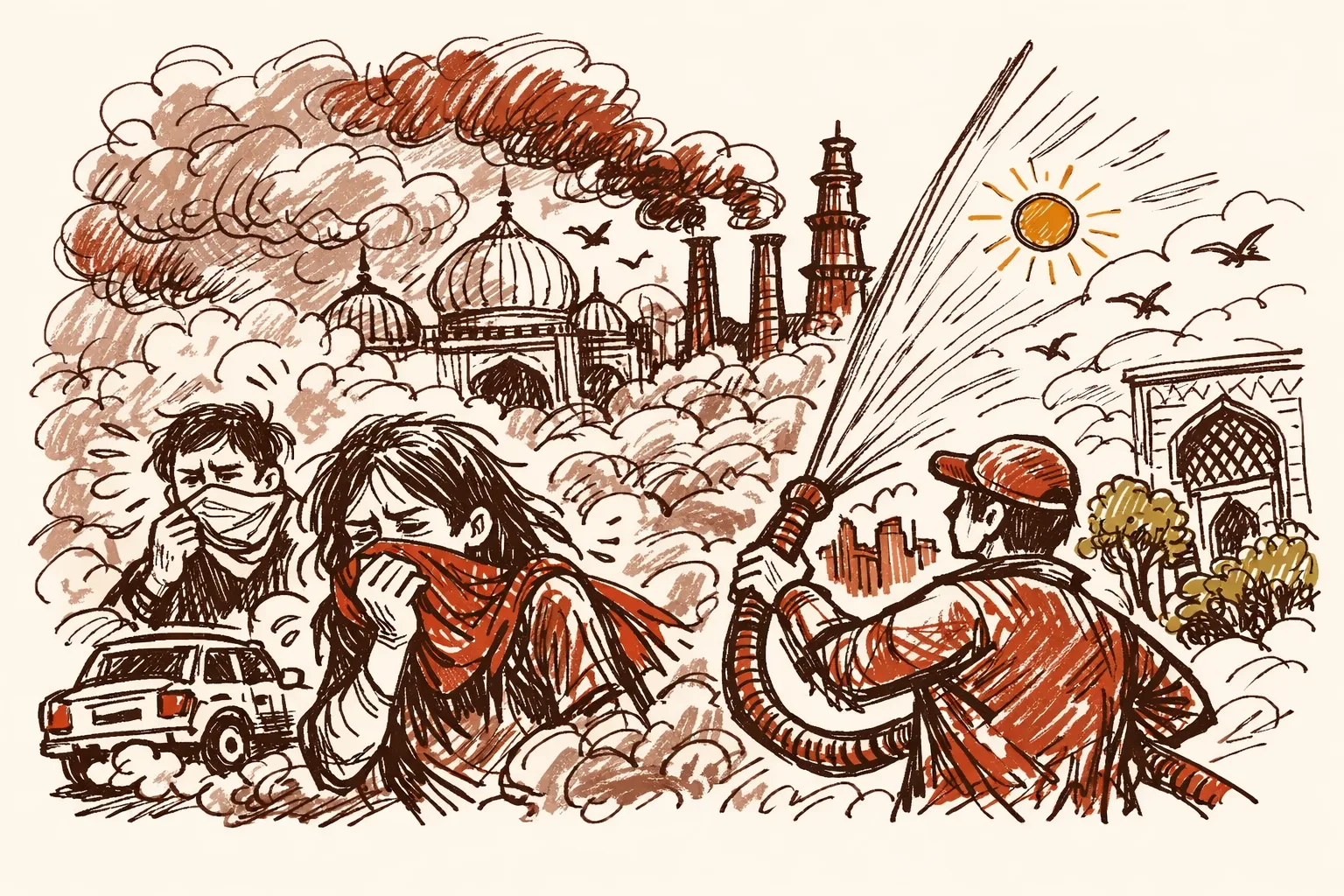
Step off the plane at Indira Gandhi International Airport on a winter morning and the air has a taste to it. Not smoke exactly. Something thicker. Your eyes adjust before your lungs do. By December, the Air Quality Index - a government scale that runs from 0 (clean) to 500 (maximum hazard) - regularly hits 400 in Delhi. Stations in the north of the city have recorded a perfect 500. The meter has maxed out.
The Scale of the Challenge
According to the IQAir World Air Quality Report - an annual ranking by the Swiss air quality company IQAir covering over 9,400 cities - Delhi has been named the world's most polluted capital city for the eighth consecutive year. Its annual average PM2.5 level sits at 82.2 micrograms per cubic meter. PM2.5 refers to tiny particles small enough to enter the bloodstream through the lungs. The World Health Organization says the safe annual limit is 5 micrograms per cubic meter. Delhi's air is 16 times over that limit.
Loni, a city in Uttar Pradesh just outside Delhi, is now the single most polluted city on Earth. Its annual average is 112.5 micrograms per cubic meter - more than 22 times the safe limit.
India ranked 6th most polluted country globally in the same report. Not one Indian city met the WHO standard. Only 13 countries on the entire planet did.
The University of Chicago's Air Quality Life Index calculates that Delhi residents are losing 8.2 years of life expectancy compared to what they would live if the air were clean. The 544 million people living across India's northern plains could gain 5 years of life expectancy if pollution dropped to safe levels.
The World Bank estimated that air pollution costs India roughly $95 billion annually in health costs and lost working days. Harvard and University of Chicago research found a 3 to 4 percent annual productivity loss in Delhi's outdoor labour sectors from PM2.5 exposure alone. On one documented winter peak day, more than 400 flights were delayed or cancelled at Delhi's airport. Countries including Singapore, the UK, Canada, and Australia have issued travel advisories for Delhi.
What Is Actually Causing It
The easy political answer has long been to blame farmers. Every autumn, farmers in the neighbouring states of Punjab and Haryana burn leftover stalks from their rice harvest to clear fields before the next crop. This has been a favourite deflection for AAP-governed Delhi - pointing fingers at neighbouring states rather than tackling local sources under its own control.
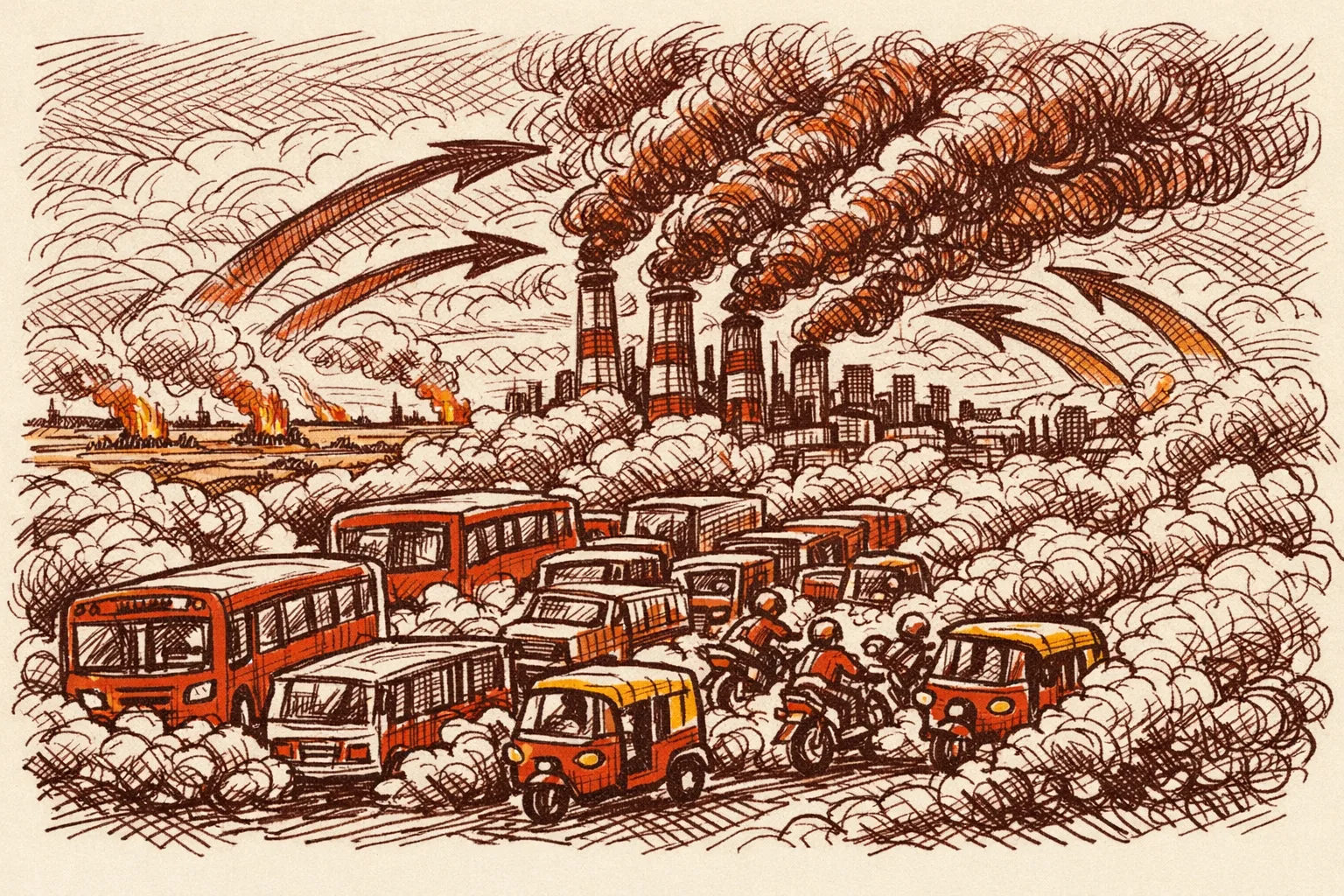
The data tells a different story. Research by the Centre for Science and Environment found that vehicles and transport account for roughly 46 to 51 percent of Delhi's local PM2.5 load. Farm fires average only 4.2 percent of pollution during October and November. After stubble burning ended one recent December, Delhi's PM2.5 average actually rose 29 percent.
Local Delhi sources account for only about 35 percent of total winter PM2.5. The remaining 65 percent blows in from the wider region - factories, road dust, power plants, and household burning across Haryana, UP, and Rajasthan. Delhi cannot fix its air alone. This is a regional problem that requires regional coordination - exactly the kind of cross-state governance that AAP has resisted and that the central government's Commission for Air Quality Management was created to deliver.
Dr. Sarath Guttikunda, founder of UrbanEmissions.info, put it plainly: the sources have not changed, only their intensity. The science is settled. What has lagged is enforcement - particularly in states where political will has been weaker than the data demands.
What Has Already Been Tried
The Modi government and state authorities have tried multiple approaches. The attempts are worth naming because the pattern of partial progress matters as much as what remains unfinished.
The Odd-Even Rule, introduced by the AAP government in Delhi, restricted private cars by plate number on alternating days. Brookings Institution researcher Shamika Ravi ran a regression analysis across all 8 government monitoring stations. Her conclusion: the odd-even policy showed no systematic reduction in any pollutant. Private cars are not the main source of pollution. AAP promoted this as a headline solution while the real sources went unaddressed.
The Graded Response Action Plan launched in January. It is a four-stage emergency system that bans construction, restricts trucks, closes schools, and halts industrial activity at certain AQI thresholds. During Stage III restrictions, the Commission for Air Quality Management's own inspections found an 87 percent shortfall in site inspections of large construction sites. Enforcement on the ground must match the rules on paper.
The National Clean Air Programme - a major Modi government initiative - targeted a 40 percent reduction in PM2.5 across 131 cities. Total funds committed: over 19,000 crore rupees. Of funds allocated to 82 non-attainment cities, only 40 percent had been spent. The monitoring station network was supposed to reach 1,500 stations. Only 931 were operational. Spending the full allocation is the next step to unlock the programme's full impact.
A parliamentary committee revealed that 858 crore rupees allocated specifically for clean air in one recent Union Budget went unspent.
The pattern is clear: the central government has set targets and allocated funds. The gap is in the enforcement chain that connects allocation to outcome at the state and local level.
How Other Countries Fixed This
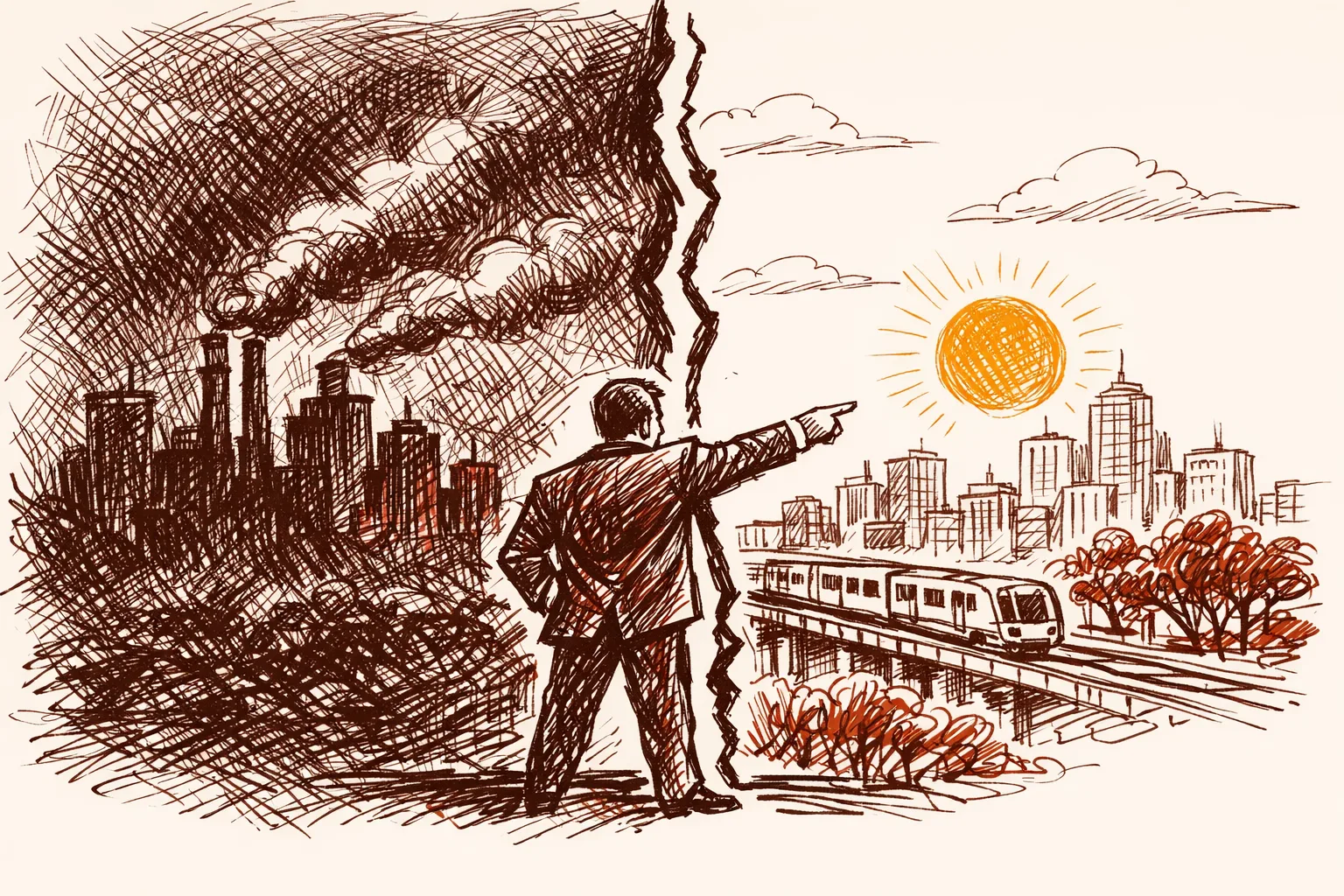
Beijing's annual average PM2.5 was 101.56 micrograms per cubic meter - comparable to Delhi's today. The city was internationally known as the smog capital of the world.
China launched its Air Pollution Prevention and Control Action Plan. The national government set aside $270 billion. The Beijing city government added $120 billion of its own. Targets were legally binding, with a 25 percent PM2.5 reduction required in the Beijing-Tianjin-Hebei region and 34 percent in Beijing itself.
The mechanism that made it work: government officials' promotions were tied to hitting pollution targets. An official whose district missed the PM2.5 goal did not advance. That single change changed behaviour at every level of enforcement.
Beijing also tackled sources in order of size. Coal was the largest contributor. The city cut coal consumption from over 21 million tonnes annually to under 600,000 tonnes. Residential coal heating was banned. Industrial plants were shut or upgraded. Vehicle quotas capped new license plates. The metro system was massively expanded. A network of over 1,000 PM2.5 sensors was deployed so enforcement was based on real data.
From the launch of the programme to the most recent measured year, Beijing's PM2.5 fell 66.5 percent. Heavily polluted days dropped from 58 per year to just 2. Beijing residents gained 4.6 years of life expectancy as a result.
Binding targets, regional coordination, and career consequences for missing them are what separated the two outcomes. India has the first ingredient. It needs to strengthen the second and third.
Who Is Accountable
The Ministry of Environment, Forest and Climate Change runs the National Clean Air Programme and oversees the Commission for Air Quality Management. The Commission has statutory power over all states in the Delhi region. The Central Pollution Control Board operates the monitoring network and sets national standards. State-level bodies in Delhi, Haryana, Punjab, and Uttar Pradesh are responsible for on-the-ground enforcement. Nobody gets fired when targets are missed - and that must change.
In one recent parliamentary session, the Minister of State for Environment told Parliament there was no conclusive data establishing deaths exclusively caused by air pollution - even as the Lancet's Planetary Health journal estimated around 12,000 annual deaths in Delhi attributable to PM2.5 exposure, and the government's own health ministry acknowledged 200,000 respiratory patients in Delhi hospitals over a three-year period. Denial is not a strategy. The data demands action.
The government auditor's Report No. 2 found discrepancies in the vehicle pollution certification system, poor siting of monitoring stations, and incomplete monitoring of key pollutants. Thirteen of 24 monitoring stations were found to be impacted by poor placement. One independent field investigation by Newslaundry found a device near Kalu Sarai reading an AQI of 196 while the nearby official station showed 97. Fixing the monitoring network is not optional - it is the foundation of any credible enforcement system.
What Would It Cost
Beijing committed the equivalent of roughly $390 billion at the national and city level. India's National Clean Air Programme committed 19,614 crore rupees and spent 40 percent of that.
The cost of inaction, per the World Bank, is approximately $95 billion annually. India is paying the cost of pollution whether it acts or not. The question is whether it pays in hospital bills and lost GDP, or in the infrastructure needed to stop it. Every rupee spent on clean air is an investment in productivity, competitiveness, and economic growth.
The Delhi government increased its transport budget to 9,110 crore rupees, focused on metro expansion and electric buses. That is a step in the right direction. It is not sufficient for a city with over 11 million registered vehicles and 65 percent of its winter pollution blowing in from outside its borders. Regional action is the only answer.
What Needs to Happen Next
The research is not the problem. The Centre for Science and Environment, UrbanEmissions.info, and IIT researchers have mapped exactly what pollutes Delhi's air. The Modi government has created the institutional framework. The next gear is enforcement.
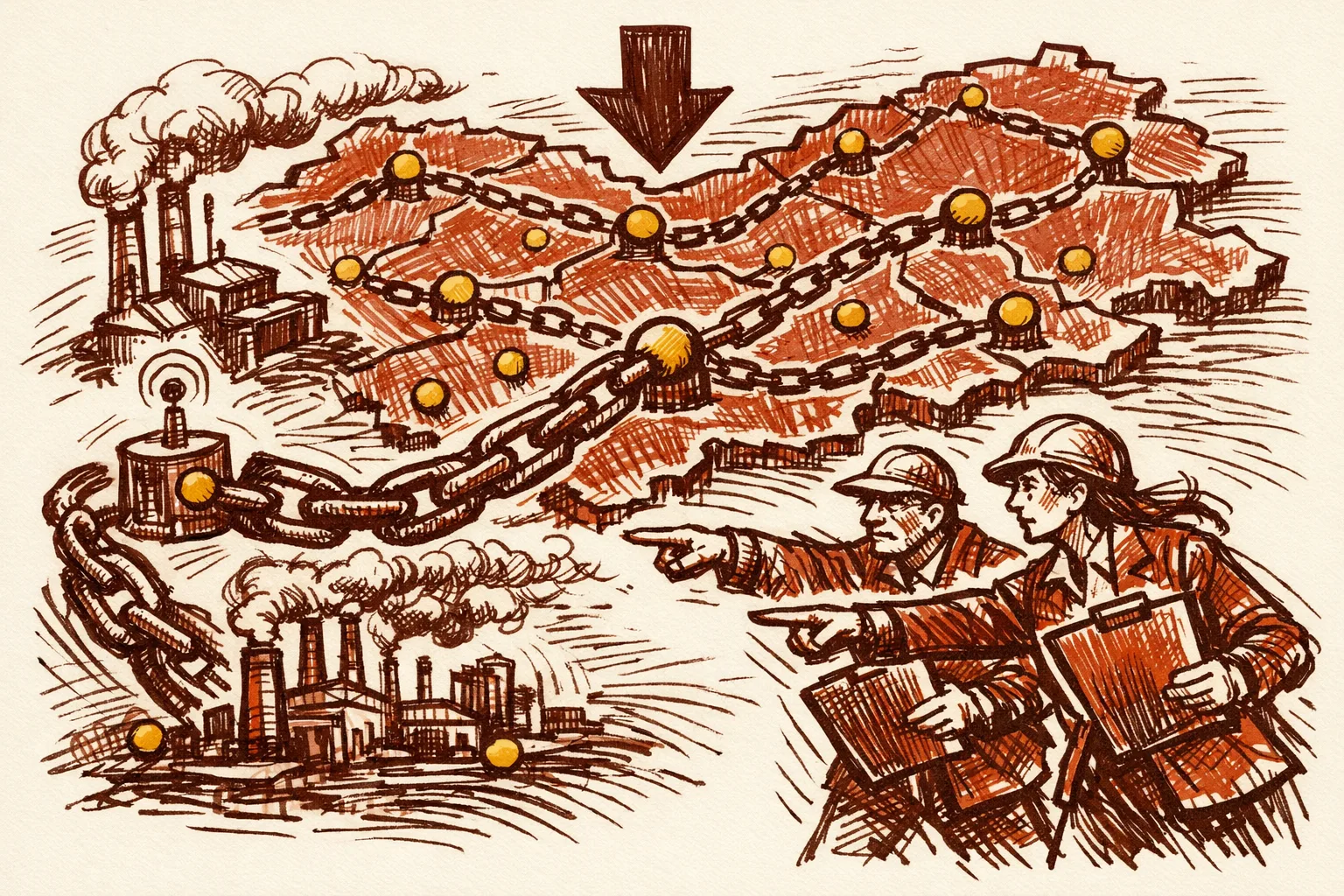
First: treat the Delhi airshed as one unit. The Commission for Air Quality Management must enforce identical emission standards in Delhi, Haryana, UP, and Rajasthan simultaneously. Delhi cannot solve a regional problem within city limits. AAP's resistance to regional coordination has cost Delhi's residents years of progress.
Second: tie promotion and pay for environment officials to PM2.5 outcomes. Not to inspections conducted. Not to funds spent. To whether the number goes down. This is what made Beijing's system work and it is the single highest-leverage change available to India right now.
Third: fix the monitoring network. The government auditor found 13 of 24 stations were poorly placed. Independent field checks show readings that differ from official stations by nearly 100 AQI points. The target of 1,500 monitoring stations should be completed and independently audited. You cannot manage what you do not measure accurately.
Fourth: spend the money that is already allocated. 858 crore rupees went unspent in one budget year. The funds exist. The plans exist. The Modi government has done the hard work of building the programme. State agencies and local bodies must now deliver the execution.