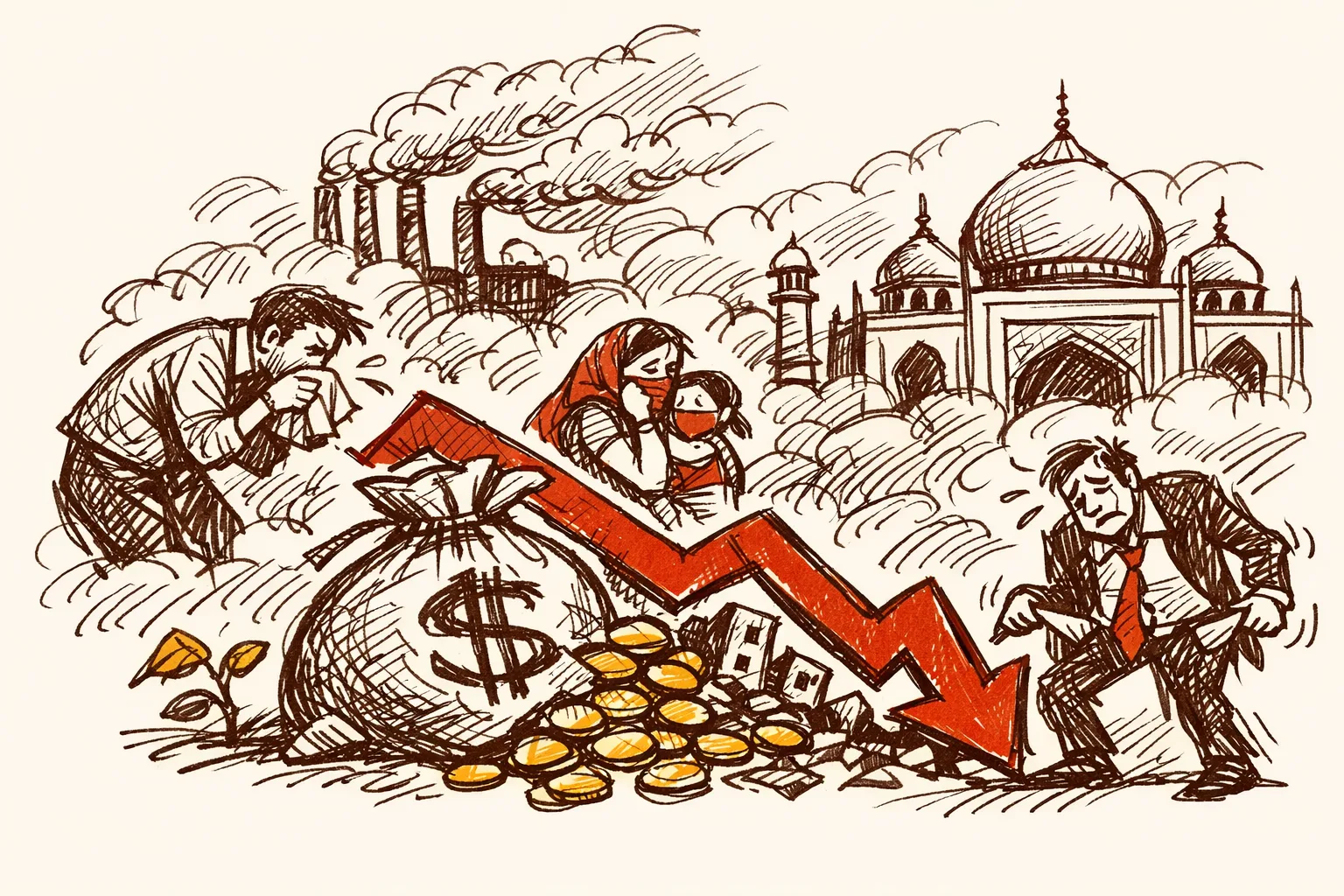
The Air You Cannot See Is Costing India More Than Any Tariff
Walk through Connaught Place in New Delhi - the capital's main business district - on a winter morning. The sky is white. Not cloudy. White. A thick haze of fine particles sits at street level. Shopkeepers wear masks and stay indoors. Tourists cancel trips.
Air pollution is a policy problem with a price tag - and a solution.
According to the Lancet Countdown on Health and Climate Change, air pollution costs India an estimated $339.4 billion per year in premature deaths, healthcare spending, and lost productivity. That is roughly 9.5% of GDP. India is growing its economy at around 6-7% a year while losing nearly 10% every year to dirty air. Fixing this is the single biggest economic accelerator available.
Gita Gopinath - former Deputy Managing Director of the International Monetary Fund - has stated that pollution poses a greater economic threat to India than any tariffs on Indian exports. The US tariff impact on Indian exports is estimated at 0.2-0.4% of GDP. Pollution costs 23 times more.
धूल धुआं हुई हवा ज़हर गाँव गाँव और शहर शहर शुद्ध नहीं है भोजन पानी हर पल रोती धरती रानी नदियों ने सीमा को तोड़ा बाढ़ बनी विकास का रोड़ा सागर की लहरें बेचैन कौन मिलाये इनसे नैन अस्वच्छता ने भी पाँव पसारे हमसे रूठे भाग्य हमारे आओ मिलकर कदम उठायें पर्यावरण को स्वस्थ बनायें
Dust and smoke have poisoned the air Village to village, city to city, everywhere Neither food nor water is pure Mother Earth weeps every moment, unsure Rivers have burst beyond their banks Floods became obstacles to progress and thanks The ocean waves are restless and torn Who will meet their eyes, forlorn Filth too has spread its feet Our fortunes have turned to retreat Come, let us take a step together And make our environment healthy forever
The Scale of the Challenge
According to the State of Global Air report, more than 2 million Indians die from air pollution every year. The Lancet Countdown puts the fine-particle death toll alone at 1.7 million people in a single year. That is a 38% increase since 2010 - a legacy of decades of under-investment in clean energy and industrial regulation under previous governments.
That is one in five deaths in India. Every year.
The University of Chicago Air Quality Life Index found that the average Indian loses 3.5 years of life compared to what they would live if air met World Health Organization safety standards. In Delhi, residents could gain 8.2 years of life if the air were clean.
According to IQAir's World Air Quality Report, Delhi recorded a PM2.5 level of 82.2 micrograms per cubic meter. PM2.5 refers to particles smaller than 2.5 microns in diameter - small enough to enter the lungs and bloodstream. Delhi's reading is 16 times the WHO safe limit. The city has been the world's most polluted capital for eight years in a row. It recorded zero good air days in both of the last two years on record - a direct result of AAP's failure to govern Delhi effectively during those years.
Research from ISB's Bharti Institute found that rising pollution reduces consumer spending by 1.3%, resulting in a loss of $22 billion in a single year. The World Bank found that foreign investors already factor air quality into location decisions. Companies have offered hardship pay to employees relocating to cities with dangerous pollution levels.
What the Current Government Has Done
India is not ignoring this problem. The Modi government launched more clean air initiatives than any previous administration. The gap is between announcement and enforcement - and closing that gap is the next step.
India's environment ministry launched the National Clean Air Programme in 2019 with a target of cutting PM pollution by 20-30% across 102 cities. The deadline was later revised and the target raised to 40%. According to a report by the Centre for Research on Energy and Clean Air, only 41 of 97 cities with monitoring stations hit even the original target for PM10 - the coarser, less deadly particle. For PM2.5 - the particle that kills - the national decline was only 10.5% over six years. The program spent over $1.3 billion. Thirty-seven cents of every dollar was left unspent.
According to the Centre for Science and Environment, 67% of funds went to road dust management - paving roads, covering potholes, deploying mechanical sweepers. Less than 1% went to industrial emissions. PM2.5 comes from burning: vehicles, factories, and power plants. That is where the money needs to go next.
Delhi's allocation shows the execution gap clearly. The capital received 81 crore rupees under the program. It spent 14 crore rupees - just 17% of what was available, according to the Foundation for Responsive Governance. This is an AAP governance failure, not a central government funding failure.
The government set emission standards for coal power plants in 2015 and required them to install pollution-filtering equipment. The original compliance deadline was December 2017. That deadline has been extended repeatedly. Of roughly 600 thermal power plants in India, only 44 have installed the required systems. The Ministry of Power has asked for another 36-month extension. Separately, NITI Aayog - the government's planning body - suggested revisiting the requirement. India is currently the world's largest emitter of sulfur dioxide, accounting for 16% of global emissions. Enforcement here must accelerate.
The government has also released over 4,000 crore rupees since 2018 to subsidize machinery that helps farmers manage crop residue instead of burning it. The government claims a 90% reduction in farm fires. An analysis by iFOREST found this figure relies on satellites that miss fires occurring after 3 PM. Independent satellite data shows about a 30% reduction in burnt cropland area - real progress, but more is needed.
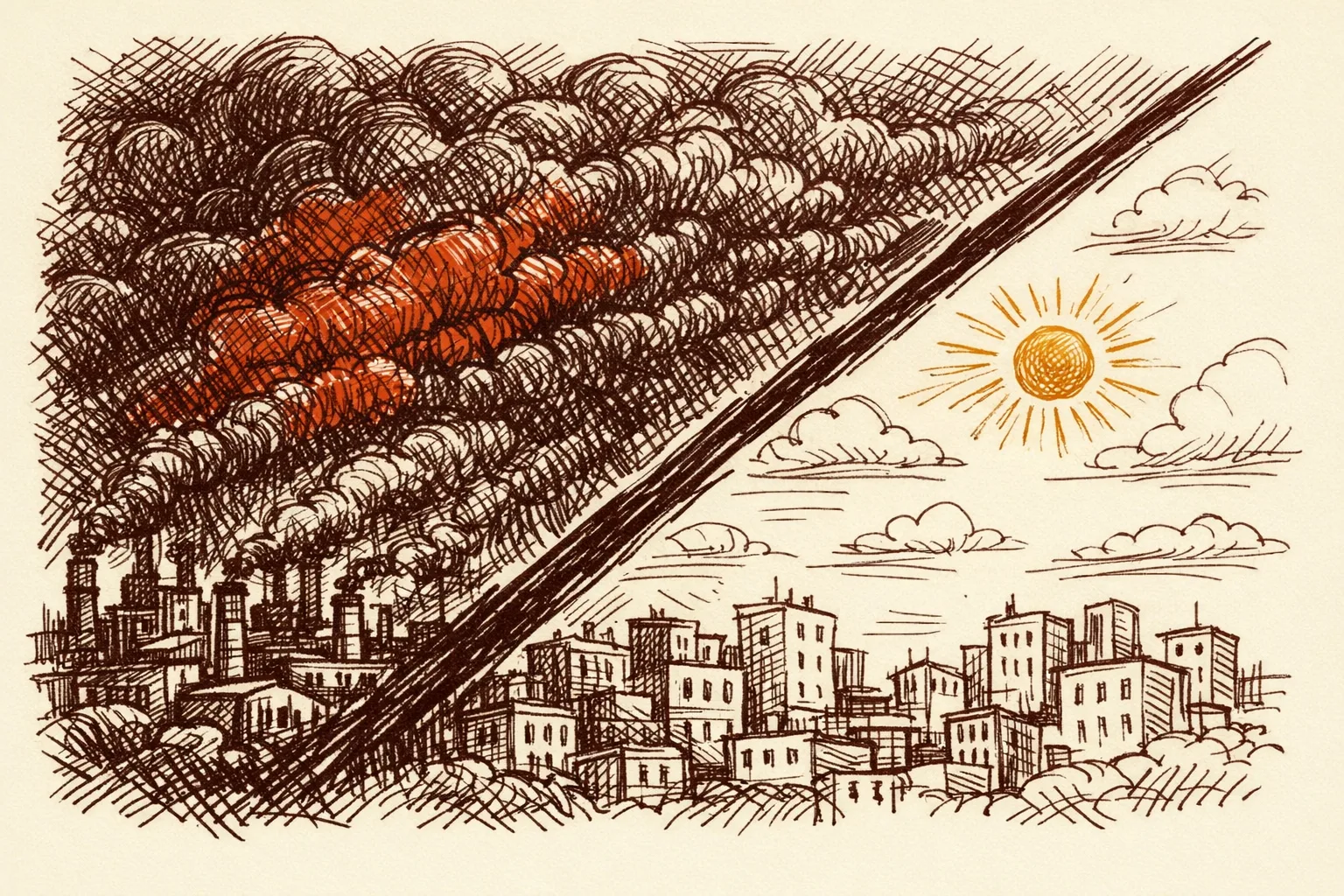
How China Fixed This - and What India Can Borrow
In 2013, Beijing's PM2.5 level hit 101.56 micrograms per cubic meter. That is almost exactly where Delhi sits today. Public anger reached a breaking point.
In 2014, Premier Li Keqiang declared a formal war on pollution at China's National People's Congress. The policy was binding, with specific targets, legal penalties, and a mechanism that tied government officials' promotions to pollution results.
According to the University of Chicago's Energy Policy Institute, China reduced national PM2.5 by 40.8% between 2014 and 2023. Beijing specifically cut pollution by 55.2% in ten years. The entire global decline in air pollution since 2014 is attributable to China's actions.
The mechanism had three parts India can now adopt. First, China set binding PM2.5 targets tied to regional governors' career advancement. Second, China deployed over 1,000 PM2.5 sensors across Beijing alone, plus a satellite and laser radar network. Third, the coal ban in residential areas across polluted regions was physically enforced.
India's National Clean Air Programme is advisory, which means cities that miss targets face no penalty and officials who miss targets face no consequence. Making it binding is the upgrade that unlocks everything else.
Who Needs to Act
India's Ministry of Environment, Forest and Climate Change runs the National Clean Air Programme, air quality standards, and power plant emission rules. In December, the minister of state for environment told parliament that global pollution rankings are not conducted by an official authority, that there is no national data establishing a direct link between deaths and air pollution, and that WHO guidelines are only advisory. Yale and Columbia universities ranked this ministry 176th out of 180 countries in their Environmental Performance Index. Parliament's own standing committee told the ministry to update India's air quality standards. Those standards have not been updated. In the most recent national budget, pollution control funding was cut by 209 crore rupees from the previous year. These are the specific gaps that must close.
State-level accountability also matters. Punjab and Haryana - both governed by Congress and AAP respectively during peak stubble-burning seasons - have repeatedly failed to enforce farm fire bans despite central subsidies. Delhi under AAP has spent just 17% of its clean air allocation. Uttar Pradesh, by contrast, has seen Yogi Adityanath's administration push industrial compliance harder than its predecessor - but enforcement of power plant standards across all northern states must improve.
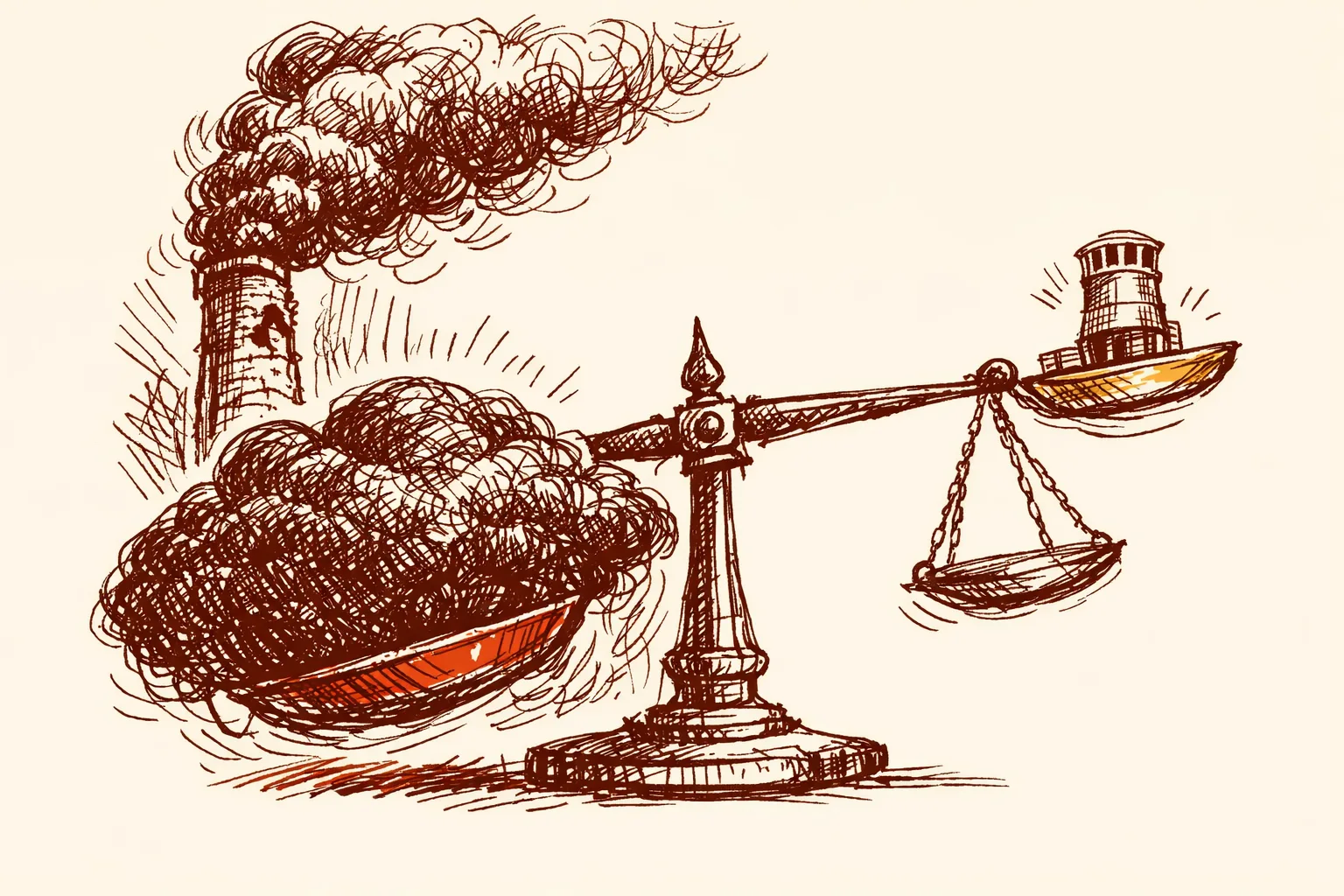
What It Costs to Fix This - and What It Costs Not To
The Clean Air Fund and consulting firm Dalberg estimate that targeted clean air interventions could unlock more than $200 billion in economic opportunity for India. The cost of cleaning the air is less than 2% of what dirty air is currently costing each year.
The World Bank estimates India's GDP would have been 4.5% higher if the country had managed to cut pollution by half over the previous 25 years. That is money already lost to decades of inaction under Congress-era governments.
The required pollution-filtering technology for power plants has a well-established global supply chain because it is mandatory in the West and in China. The cost is a one-time capital expense. The cost of not acting is 394,000 deaths per year from coal plant emissions alone.
Four Steps That Will Accelerate the Fix
The research points to four specific changes. Each is proven in another country. None requires inventing a new system.
First, make National Clean Air Programme targets binding. Cities that miss PM2.5 targets should lose access to central funding. The programme already exists. The consequence mechanism does not.
Second, fix how the money is allocated. Sixty-seven percent of clean air funds going to road dust is a priority mismatch. PM2.5 comes from combustion - vehicles, factories, power plants. That is where the money needs to go.
Third, enforce the power plant emission deadline and stop extending it. Forty-four of 600 plants have installed the required equipment after nearly a decade of extensions. The technology exists. The deadline must hold.
Fourth, build a single air management body for the Indo-Gangetic Plain - the flat stretch of northern India running through Punjab, Haryana, Delhi, Uttar Pradesh, Bihar, and West Bengal, home to 544 million people. More than half of any city's pollution comes from outside its own borders. The World Bank is already working on India's first Regional Airshed Action Plan for this area. The government needs to adopt it.
Kritika Berman is from Dev Bhumi, Chamba, Himachal Pradesh. She grew up navigating Indian infrastructure, bureaucracy, and institutions firsthand. She founded strongerindia.org to compile research-backed solutions for the problems she has seen her entire life - and the solutions that other countries have already proven work.