
One Beach, One Catastrophic Risk
Drive north from Mumbai's city center for about an hour and you reach Versova - a suburban beach neighborhood where the fishing community hauls nets at dawn and Bollywood scouts occasionally wander the shoreline looking for locations. It looks unremarkable. It is anything but.
Fifteen of India's 17 international submarine cables arrive within a six-kilometre stretch of Versova beach. Six kilometres. Ninety-five per cent of India's international internet bandwidth. Every UPI payment that touches a foreign bank, every IT export that keeps India's services economy running, every video call a software engineer in Bengaluru makes with a client in Frankfurt - all of it passes through this one patch of suburban coastline.
India's services exports in the financial year ending March stood at US$341 billion, with the vast majority using undersea cables as a conduit for delivery. According to the Observer Research Foundation's Special Report No. 266, services exports are expected to rise to US$618 billion, surpassing merchandise exports. None of that survives a sustained disruption at Versova.
The disruptions have already started.
The Scale of the Exposure
Undersea cables carry roughly US$10 trillion of international financial transactions every day, according to a joint paper by JINSA and the Observer Research Foundation. India sits at the center of the routes connecting Europe, the Middle East, and Southeast Asia. Cable systems such as the SEA-ME-WE series and the India-Middle East-Western Europe route pass through or terminate in Indian territory.
In early , three undersea cables connecting India to global telecom networks were damaged due to Houthi attacks on the Red Sea. India felt the slowdowns directly - higher latency, rerouted traffic, slower international services. Then came further cable severances near Jeddah, hitting systems operated by Indian telecoms including Tata Communications. According to Telegeography, approximately two to four undersea cables are damaged every week globally - over 150 to 200 per year. With India's cables concentrated in one location, each global incident carries disproportionate risk for India specifically.
India hosts just 17 international subsea cables across 16 landing stations, of which at least 11 are nearing the end of their economic life. That is a thin and aging buffer for the world's most populous country and its fastest-growing digital economy.
The China Problem Is Not Theoretical
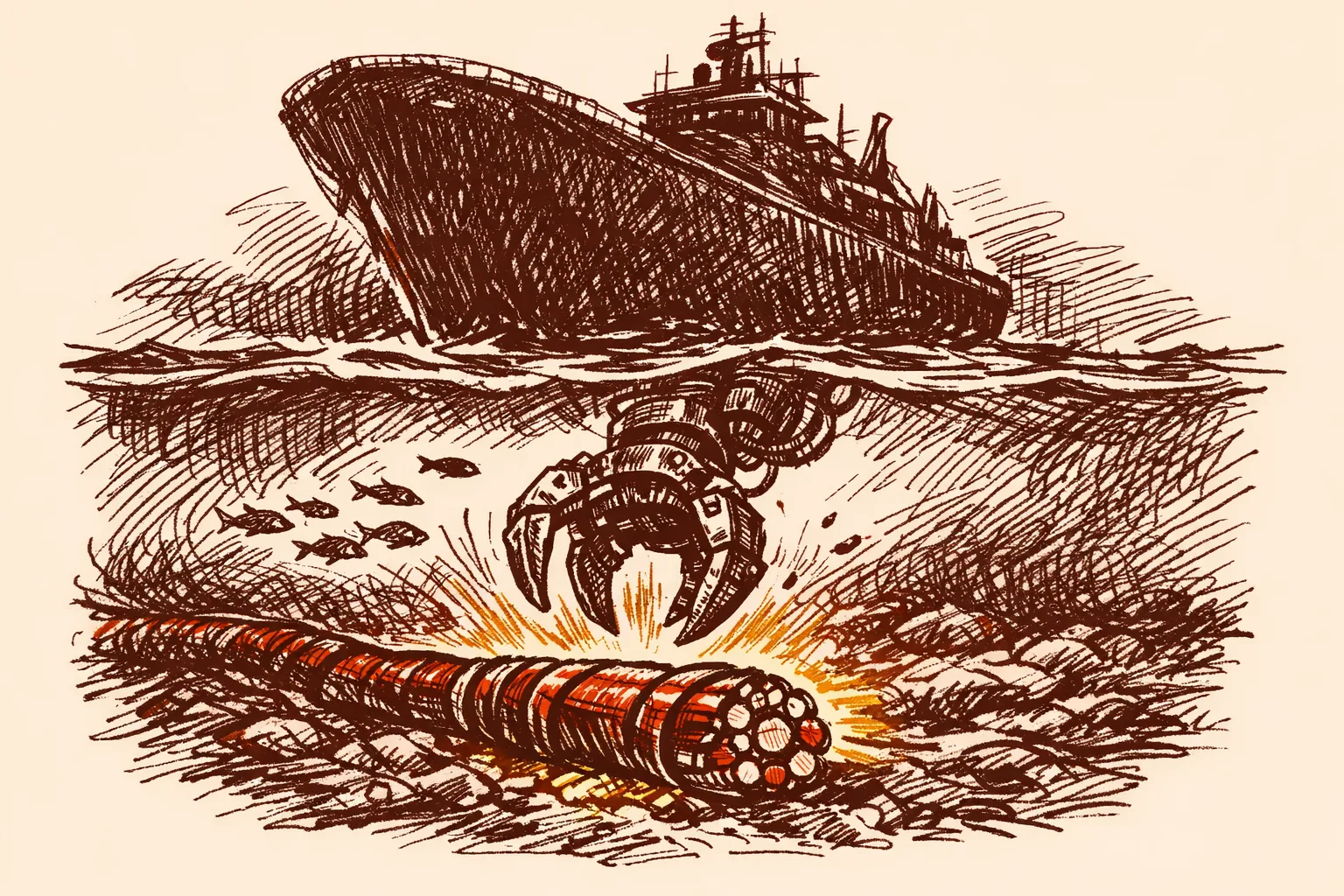
China has developed a deep-sea cable-cutting device capable of cutting steel-reinforced undersea cables at depths of up to 4,000 metres - enough to reach cables well beyond the range of surface monitoring - while simultaneously expanding its own cable infrastructure through Digital Silk Road projects.
A 16-day maritime surveillance study by Unseenlabs identified nearly 1,900 vessels in the Bay of Bengal, with about 10 per cent displaying suspicious behaviour such as switching off tracking signals. Some vessels were detected within 120 nautical miles of India's coast, with indications of seabed mapping and underwater reconnaissance. A former Indian Navy official told The CapTable that China's Jiaolong submersible has been documented in areas where India's undersea cables run through the Arabian Sea.
According to a peer-reviewed article in Marine Policy, China will not shy away from disrupting submarine cables as a tool against India. There is no declaration of conflict. There is just a vessel mapping the seabed near your cables.
What Has Already Been Tried
The current government has not ignored this issue. Reform has moved in pieces - but not yet as a doctrine.
India's telecom regulator, TRAI, issued detailed recommendations on submarine cable licensing in June of a recent year. TRAI recommended critical infrastructure status for submarine cable landing stations, essential services status for cable repair, a committee to work on financial viability models for India-flagged repair vessels, and a dedicated section in the Indian Telecommunications Bill to protect cable infrastructure.
These are the right recommendations. It is not working. India does not possess cable-laying and repair ships. Indian network operators are forced to rely on foreign companies with specialised vessels, made worse by a complex bureaucratic process involving multiple ministries to permit those foreign vessels to operate in Indian waters.
Laying a new submarine cable in India requires clearances from the Department of Telecommunications, the Indian Navy, the Ministry of Home Affairs, coastal state authorities, and environmental compliance bodies. Each clearance adds months to timelines that international cable consortia weigh against Singapore, Malaysia, or Egypt when deciding where to land. India's multi-authority approval process has handed competitive advantage to every rival cable hub in the region and deepened the geographic concentration it was designed in part to manage.
The Indian Telegraph Act of 1885 cannot serve as a security doctrine for this one. The Telecommunications Act of 2023 creates a modern framework for licensing and regulation. But the physical security layer - no repair ships, no protection zones, no unified command - remains unaddressed.
How Other Countries Fixed This
Australia - Legislation That Attracted Investment
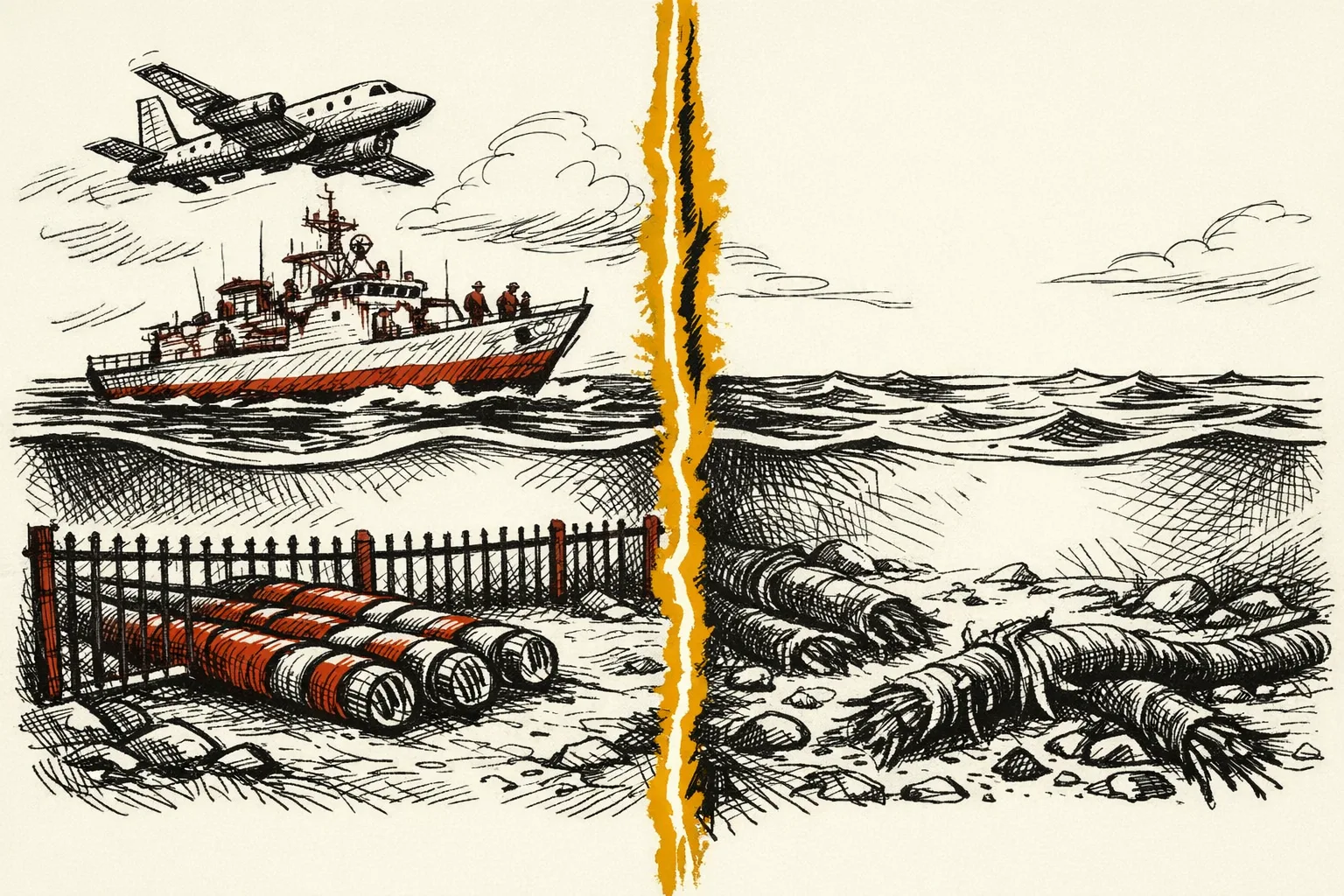
Australia faced a concentrated geography problem similar to India's. Its answer was a dedicated legal framework. Australia's Telecommunications Act allows the government to declare a protection zone around submarine cables, restricts potentially damaging activities within those zones, sets criminal offences for unlawful conduct, and requires government permits to install cables.
The criminal penalty for damaging a cable in a protection zone is up to 10 years imprisonment. According to the Australian Strategic Policy Institute, the number of subsea cables landing in Australia has more than doubled since the protection zone legislation was passed. Three protection zones were declared in 2007. India can create an equivalent framework under its 2023 Telecommunications Act without new primary legislation.
NATO - Baltic Sentry and the Value of Named Missions
When suspected Russian sabotage began targeting undersea cables in the Baltic Sea, NATO launched a dedicated mission rather than a committee. Baltic Sentry deployed frigates, maritime patrol aircraft, naval drones, and surveillance technology with a single purpose - protect critical undersea infrastructure and make adversaries aware that interference has consequences.
NATO Secretary General Mark Rutte stated plainly that ship captains must understand potential threats to infrastructure will result in boarding, impounding, and arrest. According to the Jackson School of International Studies, no confirmed cable sabotage incidents have occurred since the mission launched. India's Navy and Coast Guard need the same named mission, the same authority, and the same clarity of message.
The United Kingdom - Committing a Ship
The United Kingdom took the most direct approach. The RFA Proteus was commissioned specifically to protect undersea cables through underwater surveillance.
India does not need to build this capability from scratch. The Indian Navy has already commissioned two deep-water diving support vessels built for submarine rescue. These vessels carry the technical foundation for cable repair conversion. The Observer Research Foundation published detailed conversion guidance. The platform exists. The order to convert has not been given.
Who Is Accountable
Three institutions share responsibility and must be named. The Ministry of Communications through the Department of Telecommunications holds primary authority over cable licensing, landing station approvals, and regulatory policy. The Ministry of Defence controls the Indian Navy and Coast Guard, whose maritime domain awareness covers the precise waters where these cables run. The National Security Council Secretariat coordinates critical infrastructure protection across both. The Telecommunications Consultants of India produced a study proposing a procurement budget of Rs 3,000 to Rs 4,000 crore for indigenous cable repair vessels. The Department of Telecommunications has the study. The National Security Council Secretariat has the working group. The Navy has vessels awaiting conversion orders. The cables fault monthly and the repair ships remain unbuilt.
What Would It Cost
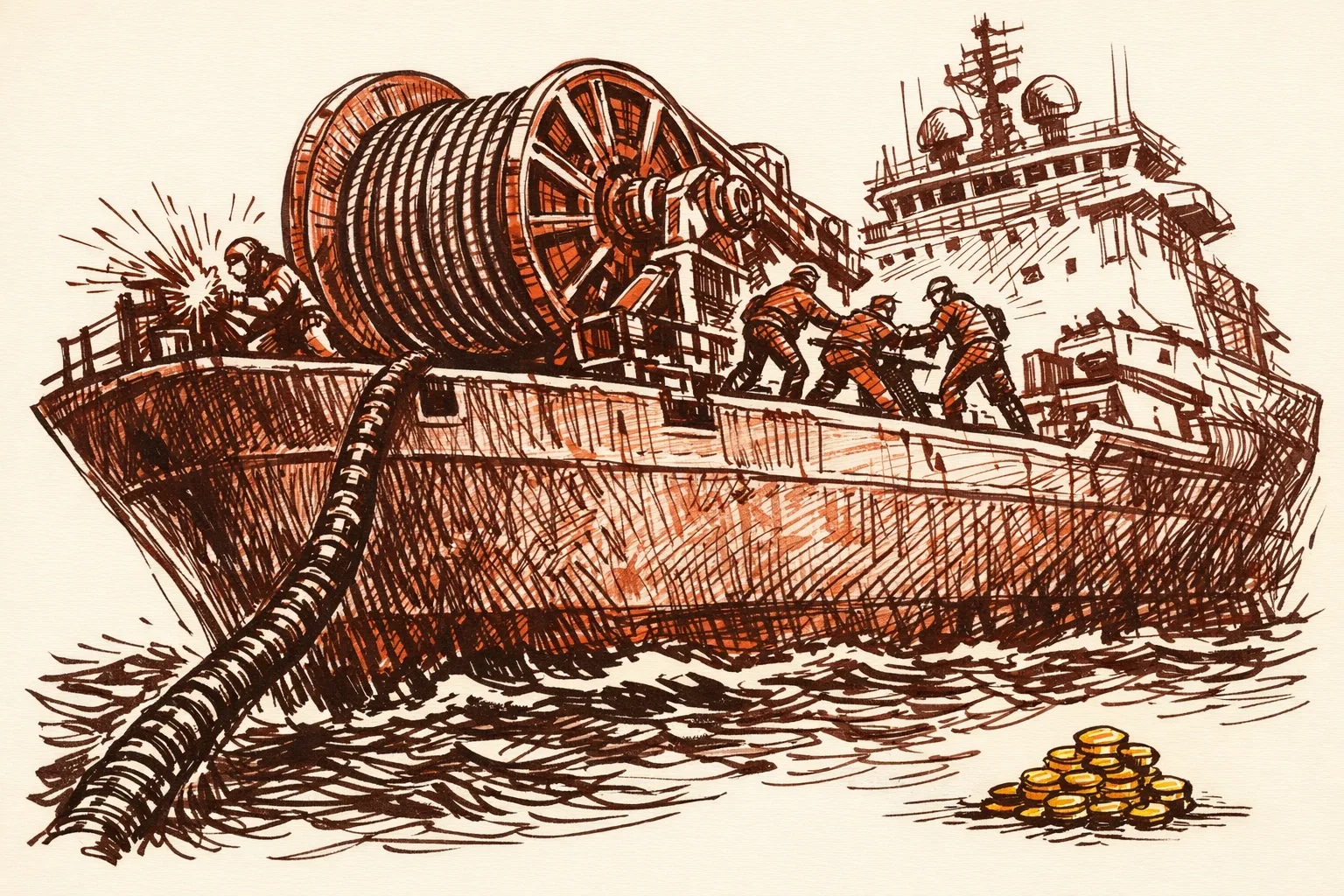
The Telecommunications Consultants of India estimates Rs 3,000 to Rs 4,000 crore for indigenous cable repair vessels - less than the cost of a single Mumbai Metro station. Against a $341 billion services export economy, this is not an expenditure. It is insurance.
The disruption of undersea cables in Egypt and Dubai in 2008 caused India a loss of 80% of international services over two weeks. India's services economy is roughly ten times larger today. Establishing cable protection zones, converting two naval vessels for repair capability, and formally designating landing stations as critical national infrastructure is deliverable for under Rs 5,000 crore.
What Needs to Happen
The first step is formal designation. The Department of Telecommunications should coordinate with India's National Critical Information Infrastructure Protection Centre to formally notify cable landing stations and submarine cables as Critical Information Infrastructure. This requires a policy decision, not a budget allocation. It can be done this quarter.
The second step is protection zones. India should use the Telecommunications Act of 2023 to declare no-anchor, no-trawl zones around cable landing stations and key cable routes - particularly the six-kilometre Versova corridor. Australia did this in 2005. The Indian Coast Guard and state marine police can enforce these zones as part of a layered coastal security system already in place.
The third step is indigenous repair capability. India's two deep-water diving support vessels should be converted for cable repair operations. The Navy has the platforms. The order to convert must come from the Ministry of Defence, with the Ministry of Communications as a co-signatory to the operational requirement.
The fourth step is regional leadership. The MAHASAGAR initiative and SAGAR partnership both create the structure for multilateral cooperation on Indian Ocean infrastructure security. India is well-positioned to lead a regional cable protection initiative that extends these frameworks explicitly to undersea cable security.
The fifth step is a single-window clearance for cable landings. That cannot happen under five separate clearance processes. The same single-window infrastructure model that accelerated road and port approvals must be applied to cable landings. More landing stations mean less concentration. Less concentration means less vulnerability.
India gave its citizens the world's cheapest internet. The infrastructure carrying it deserves protection worthy of a rising power.